Crypto Market Weekly Outlook: Fed Watch and The Big Tech Earnings Reports, Jan 27th


Key takeaways
- Bitcoin is struggling to compete with Gold, which just smashed the historic $5,000/oz barrier. While BTC dominates alts, it is currently losing the flight to safety bid to precious metals.
- In the upcoming FOMC meeting, interest rates are expected to remain unchanged in the 3.5%–3.75% range.
- Ethereum is still digesting the early-January BPO hard fork, and price action has been underwhelming.
- Bitcoin is absorbing capital flows that would normally leak into alts.
Market overview
As the market heads into the final week of January. It is without strong conviction in either direction. Optimism around the brief pop around Bitcoin’s mainnet anniversary has already faded into the background. Added to this, ETF outflows from exchanges last week were $1.7 billion the highest since November, 2025.
However, the elephant in the room is the divergence between Gold and Bitcoin. While Gold has rallied to new highs above $5,000, Bitcoin has failed to catch the same safe-haven bid, trading heavily around $88,000. This suggests that traditional capital is fleeing to physical commodities rather than digital assets in the face of trade war fears. If this correlation doesn't invert soon, we could see a continuation of the slide towards $80,000.
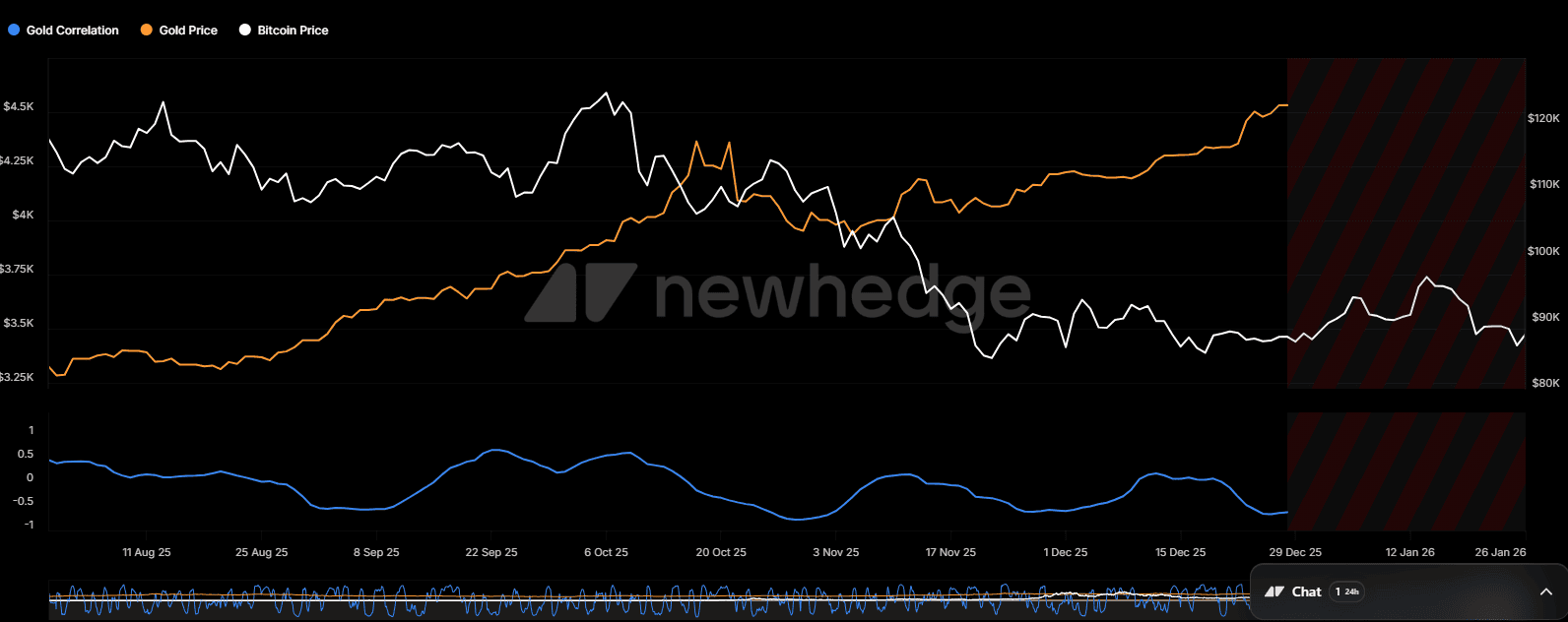
Image source: newhedge.
Now, attention has shifted almost entirely to the January 27–28 FOMC meeting, which will set the tone for the next leg, or lack of one. Interest rates are expected to remain unchanged in the 3.5%–3.75% range. That part is largely priced in.
What still matters is Fed-chair Powell’s language around the Fed’s projected final rate cut in 2026. Markets are parsing every word for confirmation or pushback.
At the same time, earnings from Apple, Microsoft, Meta, and Tesla will shape overall equity risk appetite. If tech wobbles, crypto won’t be insulated.
Risk sentiment
Neutral-leaning risk-off. The pause in proposed European tariffs has eased near-term pressure, but it hasn’t changed the bigger picture.
Ongoing geopolitical friction tied to U.S. strategic interests continues to limit aggressive positioning. Traders are cautious, and it shows.
Crypto market impact
Positioning across crypto reflects a holding pattern. Price action is closely tracking the Nasdaq as capital waits for a clearer signal before rotating back into risk. For now, crypto is trading more like a high-beta tech proxy than a standalone market.
Bitcoin (BTC) analysis
Bitcoin is still working off the momentum it lost in mid-January. In a weak tape, it remains the default parking spot for capital, but the charts show that upside pressure has cooled for now.
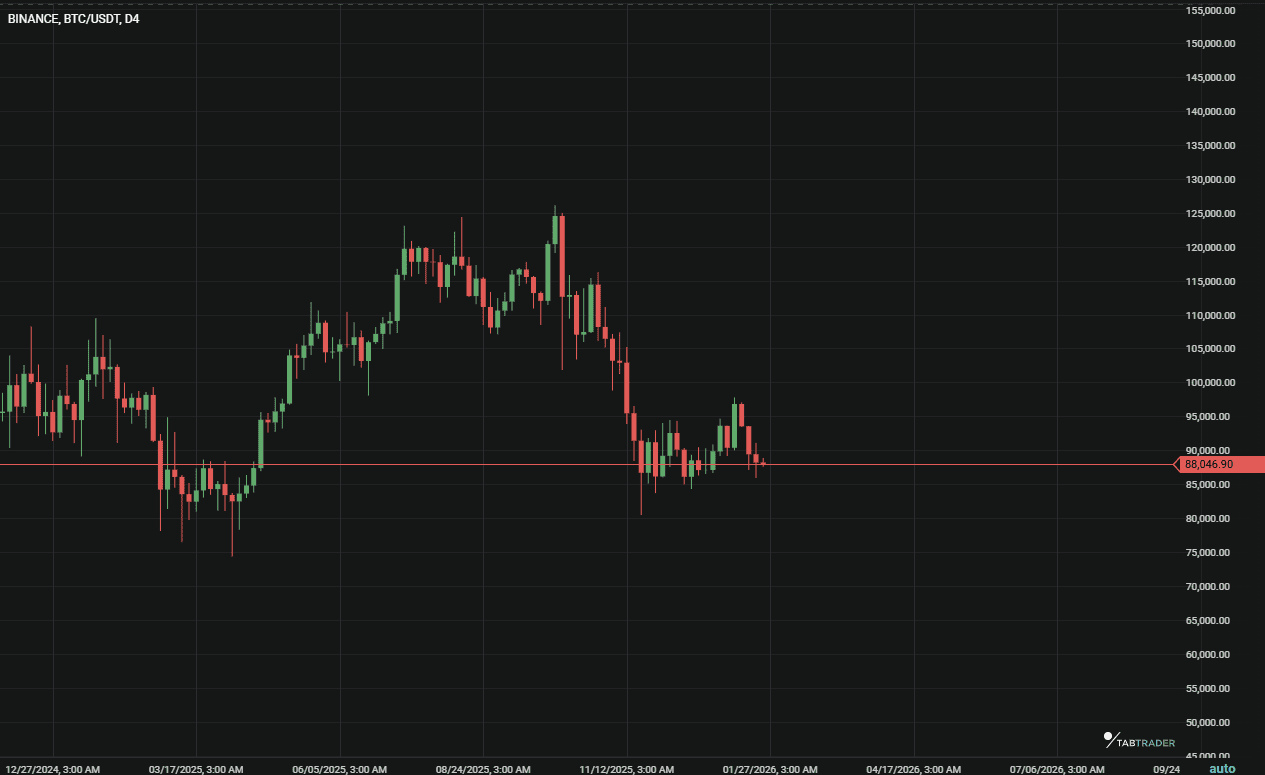
BTC/USDT
Key levels this week
BTC is trading around $88,500, sitting uncomfortably between clearly defined levels. The nearest area of real support is $86,000, a zone that has historically attracted buyers and continues to matter. On the upside, $94,000 remains the level that has to be broken before any serious discussion of six figures resumes. Until then, rallies tend to stall.
Momentum readings
Momentum indicators reflect the slowdown. RSI is hovering near 50, which lines up with indecision rather than trend strength.
The 4-hour MACD has already rolled into a bearish crossover, pointing toward consolidation rather than continuation. Price is also sitting slightly below the 20-day EMA, a small detail, but one that swing traders tend to respect.
Near-term bias
Short-term bias leans neutral to mildly bearish, while the higher-timeframe structure remains intact. Nothing meaningful has broken yet.
Tabtrader chart note
For now, BTC is stuck in a familiar chop range. A clean daily close above $94,000 would change the tone quickly.
On the other side, a liquidity sweep into the $85,000 area would likely reset positioning. Until one of those happens, expect noise and a lack of direction.
Persistent Spot ETF chatter, particularly around Bank of America, continues to act as a soft backstop, even if it hasn’t been enough to spark a move on its own.
Ethereum (ETH) snapshot
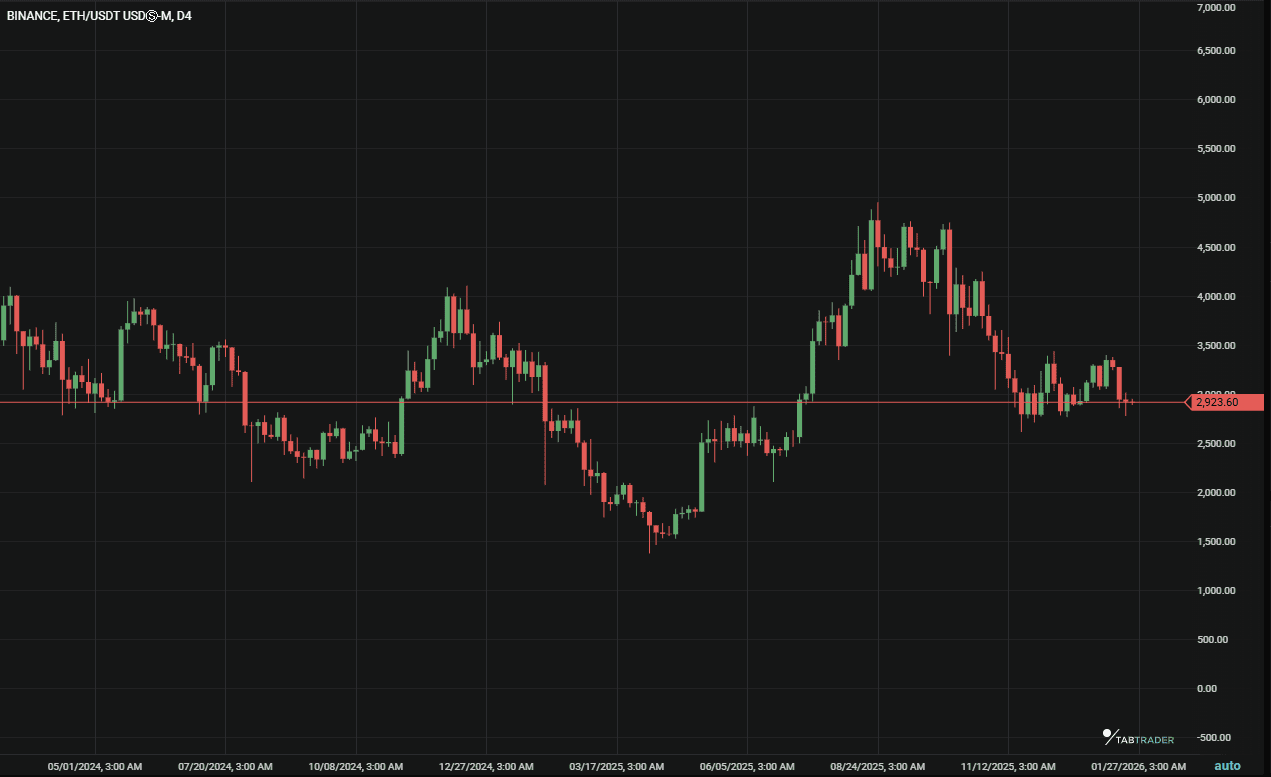
ETH/USD
Ethereum is still digesting the early-January BPO hard fork, and price action has been underwhelming.
The upgrade did what it was supposed to do. That is, higher gas limits, smoother throughput; however, the market moved on quickly. Whatever optimism was there has already been priced and then some.
The ETH/BTC ratio sits around 0.033, hovering near its yearly lows. Relative to Bitcoin, ETH continues to bleed. That underperformance is less obvious when compared to older Layer 1s like ADA or DOT, where Ethereum still looks structurally stronger.
The issue is elsewhere. A growing share of activity and mindshare is flowing to Layer 2s such as Base and Arbitrum, leaving ETH in an awkward middle ground: essential infrastructure, but not the growth trade.
Key levels
From a level's perspective, $2,800 remains the area buyers have defended so far. A loss there would likely accelerate downside pressure. On the upside, $3,250 has capped recent attempts to move higher and needs to clear before sentiment improves in any meaningful way. Until that happens, ETH looks stuck grinding rather than leading.
Major Altcoin sector overview
Layer 1s
Layer 1s are broadly neutral. Solana, trading around $133, continues to separate itself on narrative strength, with Firedancer doing most of the heavy lifting. That said, the move feels internally driven rather than demand-driven.
There’s little evidence of fresh retail capital coming in, which limits follow-through. AVAX and BNB remain functional, but uninspiring.
DeFi tokens
DeFi tokens are leaning bearish. On-chain activity tells a better story than prices do. Stablecoin usage across Tron and Ethereum is elevated, but that flow isn’t making its way into governance tokens. Capital is active and less speculative. That’s usually a headwind for this group.
Gaming
Neutral, with pockets of rotation. Legacy gaming and metaverse names continue to fade into the background. Attention has shifted toward newer narratives, particularly Hyperliquid (HYPE) and AI-adjacent hybrids. It’s less a sector-wide bid and more selective curiosity.
Altcoin sector takeaway
Relative strength is narrow. High-speed platforms like Solana and newer entrants such as Hyperliquid are holding up better than the rest of the market. Older Layer 1s and metaverse-era tokens continue to lag and, more importantly, soak up liquidity without returning momentum. Until that changes, altcoin rallies are likely to stay fragmented rather than broad-based.
Sentiment indicators
BTC dominance
Dominance is at 59% and rising; as the year goes along, it continues to creep higher. Capital is consolidating rather than rotating. In this environment, Bitcoin is absorbing flows that would normally leak into alts.
Fear & greed index
The index has slid to 29, down from 54 last month. Sentiment has cooled noticeably. Retail participation looks hesitant, with the Fed still the main overhang rather than any crypto-specific catalyst.
Stablecoin flows
Inbound stablecoin transfers to exchanges have slowed. That usually signals indecision. Traders appear content to wait for clearer price discovery instead of stepping in early.
Key events to watch this week
- Jan 27–28: FOMC meeting and press conference. This remains the primary volatility driver across risk assets. The decision itself matters less than the language and any shift in forward guidance.
- Jan 28: Tesla and Microsoft earnings. Results and commentary will influence broader tech sentiment, particularly around AI-related positioning, which continues to spill over into crypto narratives.
- Jan 30: U.S. Core PCE Price Index. This is the Fed’s preferred inflation gauge and will factor into expectations around the timing of future policy adjustments.
- Jan 28–30: WallStreetBets Live (Miami). Historically, these events can trigger short-lived speculation in meme-driven assets. Any moves are likely to be localized and narrative-based rather than structural.
Possible scenarios for the coming week
Bullish case
This case would play out if the Fed clearly opens the door to a March rate cut and Big Tech delivers clean earnings. Risk appetite returns quickly. In that setup, BTC has room to push back through $95,000, with ETH following toward the $3,400 area. Momentum would likely come from positioning rather than fresh narratives.
Neutral/Range-bound case
The Fed maintains a cautious, data-dependent stance, offering nothing new. Markets absorb the message and move on. Bitcoin continues to trade between $87,000 and $92,000, frustrating both bulls and bears. Volatility fades, and patience becomes the trade.
Bearish case
This will happen if Powell leans into the “sticky inflation” language while Apple or Microsoft disappoints. This would mean that risk unwinds across tech and spills into crypto. A $86,000 loss puts BTC back on track for a deeper pullback, with $82,000 acting as the next area where buyers are forced to show up.
Bottom line
This is a week about capital preservation, particularly through Wednesday’s Fed-related volatility. The market is caught between positive long-term crypto developments and a macro backdrop that still makes traders uneasy.
For newer participants, patience matters. Let the higher-timeframe candles close before making decisions. For more experienced traders, $86,000 on BTC is the line that matters. If it holds through the Fed meeting, the risk-reward on long setups improves meaningfully.
Don't guess. React. Set your alerts on TabTrader now. Let the price come to you.
Important Note: TabTrader does not provide investment, tax, or legal advice, and you are solely responsible for determining whether any financial transaction strategy or related transaction is appropriate for you based on your personal investment objectives, economic circumstances, and risk tolerance. Tab Trader may provide information that includes but is not limited to blog posts, articles, podcasts, tutorials, and videos. The information contained therein does not constitute investment advice, financial advice, trading advice, or any other sort of advice, and you should not treat any of the content as such. TabTrader does not recommend that any digital asset should be bought, earned, sold, lent out, or held by you, and will not be held responsible for the decisions you make.