Solana Utxo Explained: Why It Doesn’t Exist and What Traders Should Use Instead

If you spend time around Bitcoin’s on-chain analysis crowd, certain terms come up constantly: UTXO age bands, HODL waves, realized cap.
These commonly spoken-of metrics are used to track who is accumulating, who is distributing, and how long coins have actually been sitting still. They work because they map cleanly onto how Bitcoin is built.
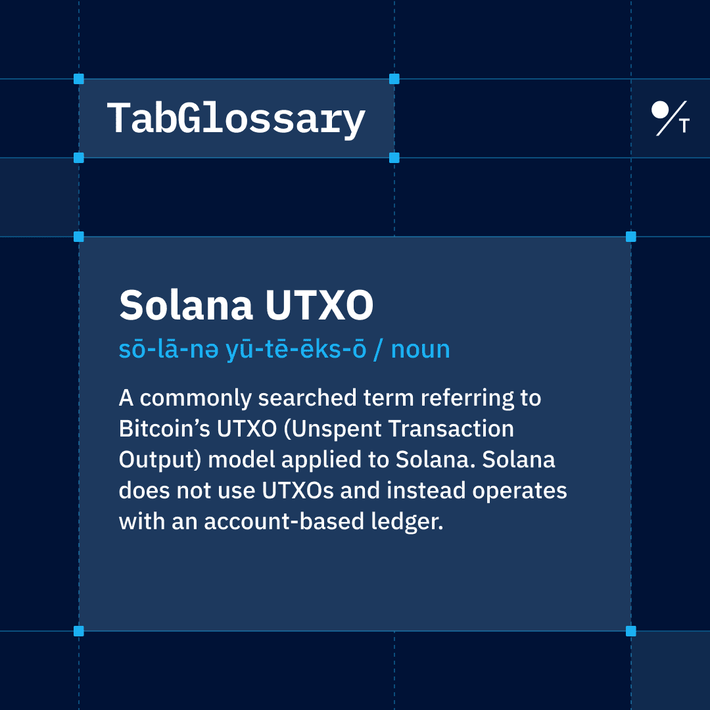
Naturally, as Solana became the center of the trading universe in 2024 and 2025, traders began searching for "Solana UTXO" metrics to gain an edge. There is just one problem: Solana doesn't have UTXOs.
The issue is straightforward. Solana does not use a UTXO model. There is no equivalent object to age, cluster, or label. Treating it like Bitcoin at the data layer leads to bad assumptions and, in turn, usually bad signals.
This guide clears that up. It explains why "Solana UTXOs" don't exist, how Solana's account-based model actually works, and, most importantly, how to reinterpret UTXO-style signals using Solana-native tools instead.
Key takeaways
- Solana does not use a UTXO model. Applying Bitcoin-style on-chain metrics to Solana produces misleading signals.
- Solana uses an Account-Based Model, similar to a digital bank ledger, which is what enables its 400ms block times.
- The account model allows parallel transaction processing via Solana's Sealevel runtime, making it fundamentally different from Bitcoin and Ethereum.
- Every popular UTXO metric has a Solana-native equivalent, you just need to know where to look.
- Trading Solana on 1-hour candles using standard exchange charts puts you behind the market. The edge lives in real-time account activity.
UTXO vs. account model: the technical core
To trade an asset effectively, you must understand the "plumbing" of the network. If Bitcoin is the gold standard of "Digital Gold," Solana is the gold standard of "Digital High-Frequency Trading." Their architectures are built for entirely different purposes.
What is the UTXO Model?
The original coin of the crypto world, Bitcoin, uses the Unspent Transaction Output (UTXO) model. To get the full picture of how it works, think of this like physical cash in your wallet. If you have a $20 bill and want to buy a $15 coffee, you don't "subtract" $15 from the bill. You hand over the $20 (the input), the barista takes $15 (output 1), and you get a new $5 bill back (output 2, or "change").
This model is a dream for on-chain analysis for crypto traders. Because every "bill" (UTXO) has a timestamp of when it was created, we can see exactly how long a specific coin has been sitting in a wallet. This is where we get "Coin Age" metrics.
What is the account model? (The Solana way)
So does Solana use UTXO? The short answer is no.
The long answer, Solana, like Ethereum, uses an Account-Based Model. Think of this like a digital bank ledger or a debit card. You have one "Account" with a balance of $1,000. When you buy that $15 coffee, the ledger simply updates your balance to $985. There is no "change," and there are no discrete "bills."
Why Solana chose accounts
This is because Solana’s goal is "Internet Speed." To achieve this, it uses a runtime called Sealevel. Because Solana uses accounts, it can process transactions in parallel.
The Solana accounts model is what allows Solana’s high speed (400ms block times) and complex DeFi (Decentralized Finance) interactions, which directly impact how you trade it compared to the Bitcoin UTXO model or the Ethereum account model.
If Trader A is buying $SOL on Raydium and Trader B is buying $BONK on Orca, Solana’s engine recognizes that these two transactions touch different "Accounts."
It processes them simultaneously. In a UTXO model, verifying these would often require a more sequential approach to ensure the "change" is handled correctly, which is one reason Bitcoin's block times are measured in minutes while Solana’s are measured in milliseconds.
How to translate UTXO metrics into Solana-native signal
Since you can't track "UTXO Age" on Solana, how do you find the same "Smart Money" signals? You have to look at the State of the accounts. Here is how to translate the most popular Bitcoin metrics into Solana-native indicators.
| Bitcoin (UTXO) metric | Solana (Account) equivalent | What it signals |
| UTXO Age (HODL Waves) | Wallet / Token Authority Age | Are "Old Wallets" (whales) selling to "New Wallets" (retail)? |
| Realized Cap | SPL Token Velocity | How much actual value is moving vs. just wash-trading volume? |
| Whale Alerts (Large UTXO movements) | Program Interaction Monitoring | Tracking when large wallets interact with DEXs like Jupiter or Raydium. |
| Exchange Inflow/Outflow | Total Value Locked (TVL) and Liquid Staking | Is capital staying in the ecosystem (JitoSOL/mSOL) or leaving? |
Technical analysis tools built for Solana's speed
Given that Solana works differently from other crypto assets, if you try to trade Solana using a 1-hour candle chart on a standard legacy exchange, you are lagging behind the market. Because of Solana’s speed, "Technical Analysis" happens on a much more granular level.
Here are the tools necessary to trade Solana successfully:
1. TVL as a leading indicator
In stock trading, you look at a company’s cash reserves. In Solana trading, you look at Total Value Locked (TVL). When TVL in protocols like Jupiter or Kamino spikes, it acts as a leading indicator for $SOL price action. High TVL means liquidity is "sticky," reducing the impact of sudden sell-offs.
2. Real-time order flow: Birdeye and DexScreener
For Solana traders, Birdeye.so and DexScreener are more important than TradingView. Why? Because they show "Real-Time Sales."
Look for "Whale Buys" in the transaction feed. On Solana, a single account can execute 10 trades in 5 seconds. If you see a cluster of buys from a single "Account," that is your "Accumulation" signal that a UTXO model would have shown as a large "Old Coin" movement.
3. The wick phenomenon: liquidations and speed
Solana charts are famous for "long wicks,” i.e vertical lines where the price drops 5% and recovers in seconds.
- The cause: High-leverage liquidations. Because Solana processes blocks every 400ms, liquidations happen nearly instantly.
- The strategy: Standard Stop-Losses often get "hunted" by these wicks. Intermediate traders use "Volatility-Adjusted Stops" or wait for a "Closing Print" on a 5-minute candle rather than setting a hard trigger that can be tripped by a 1-second wick.
4. MEV and jito: the hidden spread
Maximal Extractable Value (MEV) is a significant factor on Solana. Without protection, bots can sandwich your trades, buying immediately before you and selling immediately after, extracting value at your expense.
Jito-enabled validators allow you to bundle transactions and avoid this. A practical signal to watch: when priority fees spike sharply, it usually indicates traders are competing aggressively for block space ahead of a significant price move.
Trading strategies that use Solana's account model as an advantage
Now that we know Solana isn't UTXO-based, we can stop looking for "HODL Waves" and start using the Account Model's unique strengths.
1. Scalping sub-second finality
On a UTXO chain like Bitcoin, scalping is impossible because your "change" isn't available to spend until the next block (10 minutes). On Solana, your account balance updates in 400ms.
"Micro-Trend Following." Traders use bots or high-speed UI (like Solflare or Phantom with "Priority Fees" turned on) to jump in and out of momentum waves within a single 1-minute candle.
2. On-chain arbitrage via liquidity gaps
Because Solana has many different "Liquidity Pools" (Accounts) for the same token, prices often desync.
Use an aggregator like Jupiter. If Jupiter shows a significant difference between the price on Raydium vs. Orca, you are seeing a "Liquidity Gap." Often, the price will gravitate toward the pool with the highest depth.
3. Active account creation as a retail FOMO signal
Bitcoiners track "Active Addresses." On Solana, we track "Active Accounts." > Note: A single user can have one wallet address but interact with 50 different Token Accounts (one for USDC, one for SOL, one for BONK). When you see a surge in New Account Creation for a specific token (like a new meme coin or a DeFi protocol), that is the "Retail FOMO" signal. It is the Account Model's version of a "UTXO Age" spike.
Bottom line: stop looking for UTXOs, start reading accounts
The search for "Solana UTXO" usually stems from a desire to find the same high-conviction data we see on Bitcoin. But as we’ve discovered, Solana’s power lies in its Account Model. It is a system built for concurrency, speed, and complex DeFi logic.
The takeaway from all this is that, to trade Solana, do the following:
- Stop looking for "Coin Age" and start looking for Account Activity.
- Use tools like Birdeye to track real-time "Whale Account" accumulation.
- Respect the Wick: Solana's speed means liquidations happen faster than your eyes can blink.
Trading Solana is about mastering latency and liquidity flow. While the UTXO model is a great history book for Bitcoin, the Solana Account model is a live stream of the global market.
Important Note: TabTrader does not provide investment, tax, or legal advice, and you are solely responsible for determining whether any financial transaction strategy or related transaction is appropriate for you based on your personal investment objectives, economic circumstances, and risk tolerance. Tab Trader may provide information that includes but is not limited to blog posts, articles, podcasts, tutorials, and videos. The information contained therein does not constitute investment advice, financial advice, trading advice, or any other sort of advice, and you should not treat any of the content as such. TabTrader does not recommend that any digital asset should be bought, earned, sold, lent out, or held by you, and will not be held responsible for the decisions you make.