Crypto Market Weekly Outlook: Why is Bitcoin Down this Week and What to Watch (May 18th-22nd, 2026)

Key takeaways
- Bitcoin is down about 5% this week and down to its weakest level in three weeks.
- Markets turned more cautious after U.S. President Donald Trump issued a fresh warning toward Iran on Sunday, suggesting that continued delays in a peace agreement could lead to military action.
- Bitcoin failed to break above the $82,000 resistance zone, triggering a cascade of leveraged long liquidations estimated between $580M and $661M.
Why is Bitcoin down this week?
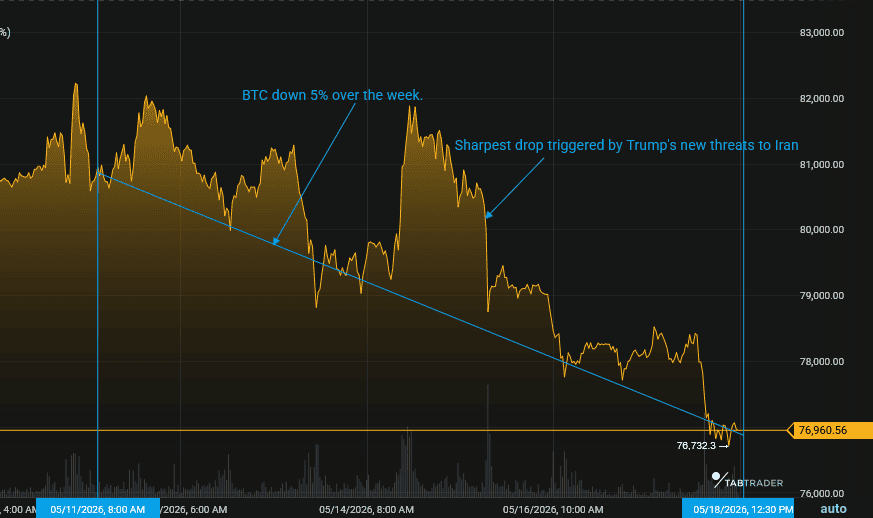
BTC down 5% week-over-week
Crypto markets are under pressure again as of May 18, with Bitcoin leading the selloff amid rising liquidations and climbing bond yields.
As of writing, Bitcoin briefly fell to $76,500, its weakest level in roughly three weeks, and Ethereum lost 9% over the past week.
Most major altcoins followed the same path. BNB, XRP, Solana, Dogecoin, and Cardano all corrected between 8% and 11%. Tron and Hyperliquid held up better than the rest of the market, posting gains of 2% and 8%, respectively.
The overall crypto market capitalization slipped 1% to $2.56 trillion, according to market data.
Sentiment has also deteriorated quickly. The crypto Fear & Greed Index dropped to 39, which puts the market firmly in fear territory. Traders are clearly shifting into defensive mode.
You can see it in positioning, funding rates, and how aggressively people are selling rallies. The mood changed fast this week. Happens every time macro pressure starts building.
Four things are driving Bitcoin lower right now:
1. Geopolitical risk re-enters the picture
Markets turned more cautious after U.S. President Donald Trump issued a fresh warning toward Iran on Sunday, suggesting that continued delays in a peace agreement could lead to military action.
“They'd better get moving, FAST, or there won't be anything left of them,” Trump wrote on Truth Social.
That headline alone was enough to push traders toward defensive positioning. Oil reacted immediately. Brent crude climbed 1.78% to $111.2, while WTI crude rose 2.2% to $107.7
Higher oil prices complicate the inflation outlook, and that matters for crypto more than people sometimes realize. If energy prices remain elevated and inflation remains sticky, the Federal Reserve is more likely to keep rates higher for longer. Risk assets usually struggle in that environment. Crypto especially tends to lose momentum when liquidity tightens, and macro uncertainty starts dominating the narrative.
2. Rising bond yields and inflation fears
Another pressure point came from the bond market.
Stronger-than-expected inflation data triggered a sell-off in U.S. Treasuries, pushing the 10-year Treasury yield above 4.5%. Traders quickly scaled back expectations for rate cuts and started pricing in the possibility that the Federal Reserve may need to stay aggressive for longer.
That shift drains liquidity from speculative markets. Bitcoin, tech stocks, and high-beta assets generally feel the impact first. The pattern has become pretty familiar at this stage: yields rise, dollar strengthens, crypto loses momentum. For context on how FOMC decisions have historically moved crypto markets, see our February 17 FOMC-focused edition.
3. The liquidation cascade: this week's defining technical event
Bitcoin also ran into a technical problem after failing to break above the key $82,000 resistance zone.
Once momentum stalled, leveraged long positions began to be wiped out. That triggered a cascade of forced selling across crypto derivatives markets, with total liquidations estimated between $580 million and $661 million.
Most of those liquidations came from bullish traders using leverage. When those positions unwind, the selling becomes automatic. Price drops trigger more liquidations, which trigger more selling. The market can get ugly very quickly once that loop starts feeding itself. Crypto traders never really learn moderation during leverage-heavy rallies. It’s the same movie every cycle.
If you want to understand the psychological patterns that drive overcrowded leverage positioning in the first place, our deep dive into crypto trading psychology covers the cognitive biases and emotional loops at work.
4. ETF outflows and whale selling
Institutional demand has also cooled off.
Spot Bitcoin ETF inflows have slowed noticeably over the past week, while on-chain data suggests larger holders are trimming exposure and taking profits after the recent rally.
That combination matters because Bitcoin has relied heavily on institutional flows this year. When ETF demand weakens, and whales begin distributing into strength, momentum traders usually pull back as well. The market loses one of its strongest sources of support, at least temporarily.
Bitcoin price analysis: May 17-22
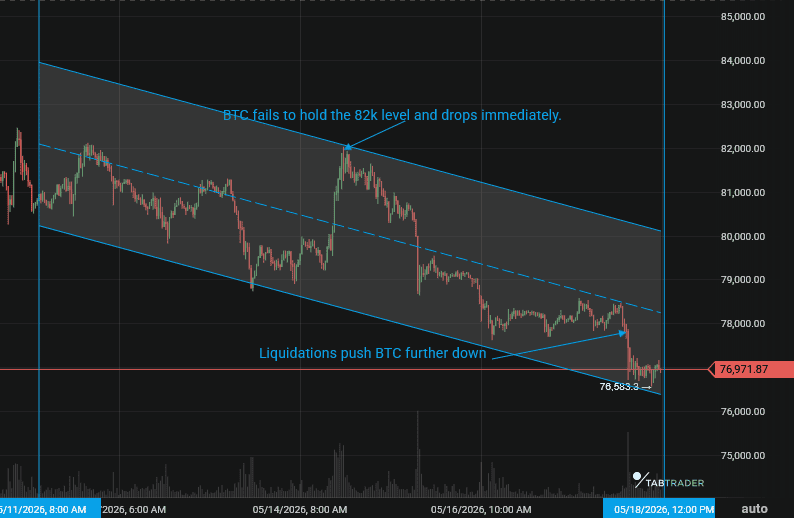
BTC/USDT.
BTC/USDT: All prices are at the time of writing and subject to change.
Bitcoin has experienced a sharp short-term reversal after failing to hold momentum near $82,000. Price has since dropped toward a two-week low, breaking below an important psychological level in the process.
One notable detail is the liquidation wick below $77,000. That move has all the fingerprints of forced deleveraging rather than orderly selling. Leveraged longs were already overcrowded, and once key support cracked, the unwind fed on itself.
Volume also expanded noticeably during the drop, which adds credibility to the move. Weak selloffs usually happen on declining participation. This one did not.
For now, the market looks unstable rather than outright broken, but buyers have clearly lost control of the short-term trend.
Current market levels
- Support: $74,000–$75,000 remains the main structural demand zone.
- Resistance: $80,000 is now acting as overhead resistance after losing support. Above that, $82,000 remains the recent swing high that sellers have aggressively defended.
Key indicators
- RSI: The daily RSI has dropped into the high-30s, reflecting increasing bearish momentum and weakening buying pressure.
- MACD: A bearish crossover has formed above the zero line, usually a sign that momentum is shifting lower rather than just cooling off temporarily.
- Moving Averages: Bitcoin has fallen below both the 20-day and 50-day EMAs. Those levels now matter less as support and more as ceiling prices need to be reclaimed.
Bitcoin needs to close convincingly above $80,000 on a daily basis before trend recovery becomes a serious conversation. Until that happens, the path of least resistance points toward the $74,000 support cluster.
For a primer on how these indicators work and how TabTrader surfaces them, see TabTrader's Top 5 Trading Indicators
Ethereum price analysis: May 18-22
ETH/USDT.
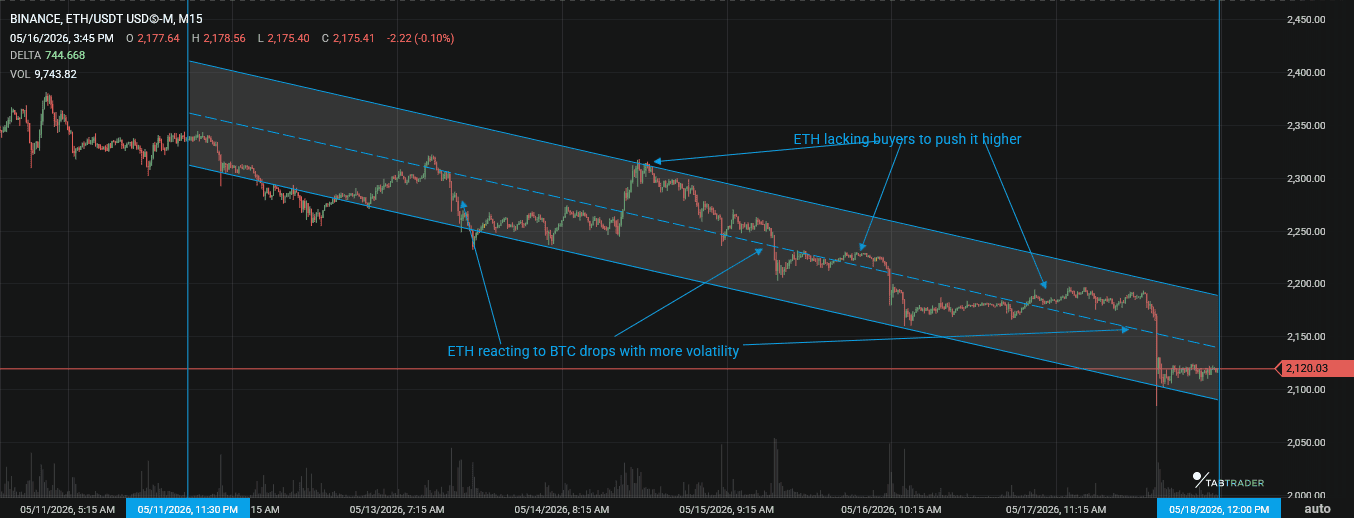
At the moment, Ethereum still looks reactive rather than leading. Bitcoin moves first, and ETH follows with additional volatility. That tends to happen during defensive market phases where traders prioritize liquidity over growth narratives.
Ethereum continues to lag behind Bitcoin, especially during periods of market stress. The ETH/BTC pair remains under pressure as traders rotate toward Bitcoin, which is still viewed as the safest and most liquid asset in crypto when volatility spikes.
According to our analysis, Ethereum currently lacks strong speculative buying from either retail traders or large institutions. Without fresh spot demand supporting price, ETH becomes more exposed to leverage-driven selloffs whenever broader market sentiment deteriorates.
That vulnerability became clear during the latest correction. Once Bitcoin started breaking down, Ethereum sold off harder as leveraged positions unwound across the derivatives market.
Key Support and Resistance Zones
- Support Zone: $2,300–$2,500 remains the main area bulls need to defend. A clean breakdown below that region would likely increase downside pressure significantly.
- Resistance Zone: $2,250–$2,300 is the first major recovery area. ETH needs to reclaim that range before momentum starts shifting back in favor of buyers.
Major altcoin sector overview
| Sector | Outlook and notes |
| Layer 1 | Bearish. High-beta ecosystems like Solana (SOL) are enduring deep pullbacks due to broad liquidations, but their structural market health remains intact compared to legacy L1S. |
| DeFi | Bearish. Native DeFi utility tokens are sliding sideways or down. However, institutional Real-World Asset (RWA) subsets are a massive bright spot, with on-chain RWAs hitting an all-time high of $33.78B this month (driven by Ondo and BlackRock's BUIDL). |
| Gaming / Metaverse | Bearish. Completely lagging behind BTC. Retail appetite has entirely evaporated from this sector, and these tokens remain highly sensitive to defensive macro shifts. |
Altcoin sector summary
Purely speculative sectors like Gaming/Metaverse and standard DeFi protocols continue to lag the broader market. Conversely, institutional infrastructure plays are demonstrating superior structural resilience. Traders are prioritizing capital preservation and tangible yield over raw speculation.
Market metrics and sentiment
- BTC Dominance: Rising steadily toward the 60% range. This signals a classic risk-averse asset rotation inside the crypto market, where traders exit altcoins to park capital in the relative safety of Bitcoin.
- Fear/Greed Index: Currently sitting at 39 (Fear). This is a sharp pullback from last week’s neutral readings, capturing the sudden macro anxiety and a flush of leverage.
Key events to watch this week
- Wednesday, May 20: US Federal Reserve (FOMC) Minutes, traders will scan the report from the central bank's April meeting to evaluate if high oil prices will force the Fed to keep interest rates higher for longer.
- All week: Watch out for developments in the Middle East. The market could drop further if President Trump follows through on his threats.
- PYTH and ZRO tokens unlock: Both projects have scheduled unlock events this week, releasing previously frozen tokens into circulation. When large amounts of supply become available, especially from early investors or team allocations , it can create selling pressure on those specific tokens. Watch for price action around unlock dates if you hold either.
Possible market scenarios for the week
The market scenarios this week hinge on geopolitical factors and the possibility that this market crash will continue.
Bearish scenario
If Bitcoin fails to hold the current area and breaks decisively below $75,000, downside pressure is likely to accelerate. In that case, the price would probably drift toward the $70,000–$72,000 zone. The move would likely be driven less by fresh selling and more by forced positioning. ETF outflows, leveraged liquidations, and traders cutting risk at the same time. Once that type of flow starts, it tends to run on its own for a while.
Neutral scenario
Another possibility is that price simply stalls here and moves sideways. In that case, Bitcoin would likely trade between roughly $75,500 and $79,500 for a few days.
This would line up with a broader wait-and-see market. Equities remain relatively quiet, and crypto traders mostly pay exposure as they watch macro headlines. The focus would shift to upcoming Federal Reserve commentary, especially the midweek minutes release, which could reset expectations around rates.
Bullish scenario
A recovery case requires a combination of macro relief and a quick reset of positioning.
If geopolitical tensions ease and the Federal Reserve signals a softer tone in its minutes, you could see a short squeeze develop fairly quickly. That kind of move usually starts with a sharp bounce off lows as overleveraged shorts get forced out.
For anything more structural, Bitcoin needs to reclaim $80,000 on a daily close. That level has now flipped from support into resistance, and the market will treat it as the real confirmation line. If that happens, a retest of $82,000 becomes the next logical area rather than a breakout extension.
Bottom line
This week is less about finding trades and more about not getting caught on the wrong side of forced moves. The market is being driven by macro conditions rather than crypto-specific momentum. Higher oil prices, sticky inflation expectations, and rising bond yields are doing most of the heavy lifting in terms of direction.
Under those conditions, crypto tends to behave more mechanically: liquidity thins out, leverage is quickly unwound, and support levels can fail faster than traders expect.
For most traders, especially those earlier in their journey, the cleaner approach is restraint. High-beta altcoins tend to react the worst in environments like this, mostly because liquidity disappears first and rebounds last. Chasing moves in that part of the market usually ends up being a timing problem rather than an analysis problem.
Until the market digests the Federal Reserve minutes due Wednesday, positioning is likely to remain cautious and reactive. Capital tends to sit on the sidelines in weeks like this rather than commit early.
FAQs
1. Why is Bitcoin Dominance rising while Bitcoin’s price is actually falling?
Bitcoin Dominance measures BTC’s share of the total crypto market cap. When the market turns bearish, Bitcoin Dominance often rises because traders view altcoins as much riskier than Bitcoin.
2. What are Token Unlocks (like PYTH and ZRO this week), and why should I care?
A token unlock is an event where previously frozen cryptocurrencies (usually allocated to early investors, team members, or development funds) are released into circulation.
3. How should a beginner or intermediate trader play this week’s outlook?
The golden rule for this week is patience over FOMO (Fear of Missing Out).
- If you are a spot trader, avoid catching a falling knife (buying an asset while it is crashing). Wait to see if Bitcoin holds the $74,000–$75,000 support level before scaling in.
- If you are a leverage/futures trader, keep your position sizes small and your leverage low. With the FOMC minutes dropping on Wednesday, artificial price spikes in both directions (liquidation hunts) are highly likely. When in doubt, sitting on the sidelines in cash/stablecoins is an active, profitable trading strategy.
TabTrader's Technical Alerts can help you monitor key levels without having to watch the the screen all day.
Spot key levels in real time, then trade smarter live on TabTrader.
Important Note: TabTrader does not provide investment, tax, or legal advice, and you are solely responsible for determining whether any financial transaction strategy or related transaction is appropriate for you based on your personal investment objectives, economic circumstances, and risk tolerance. Tab Trader may provide information that includes but is not limited to blog posts, articles, podcasts, tutorials, and videos. The information contained therein does not constitute investment advice, financial advice, trading advice, or any other sort of advice, and you should not treat any of the content as such. TabTrader does not recommend that any digital asset should be bought, earned, sold, lent out, or held by you, and will not be held responsible for the decisions you make.